Imagine spending years building an audience, creating content and generating enquiries through a platform, only to wake up one morning and discover that the rules have changed.
You can still use the platform. But something you previously relied on is now restricted, changed or sitting behind a paid subscription.
That is the risk of building your business on rented land.
Facebook has given businesses a timely reminder
A recent change being tested by Meta is a good example.
Some Facebook Pages are now being limited to two organic posts or comments containing external links per month without an appropriate paid Meta subscription. The change is not currently affecting every Facebook Page, but Meta has been expanding the test.
For businesses that regularly use Facebook to send followers to their website, blog, booking page or online store, it is a significant change. But the real lesson is bigger than Facebook.
When another company owns the platform, they also control the rules.
They can change what you can publish, how many people see it, what features are available and what you need to pay for.
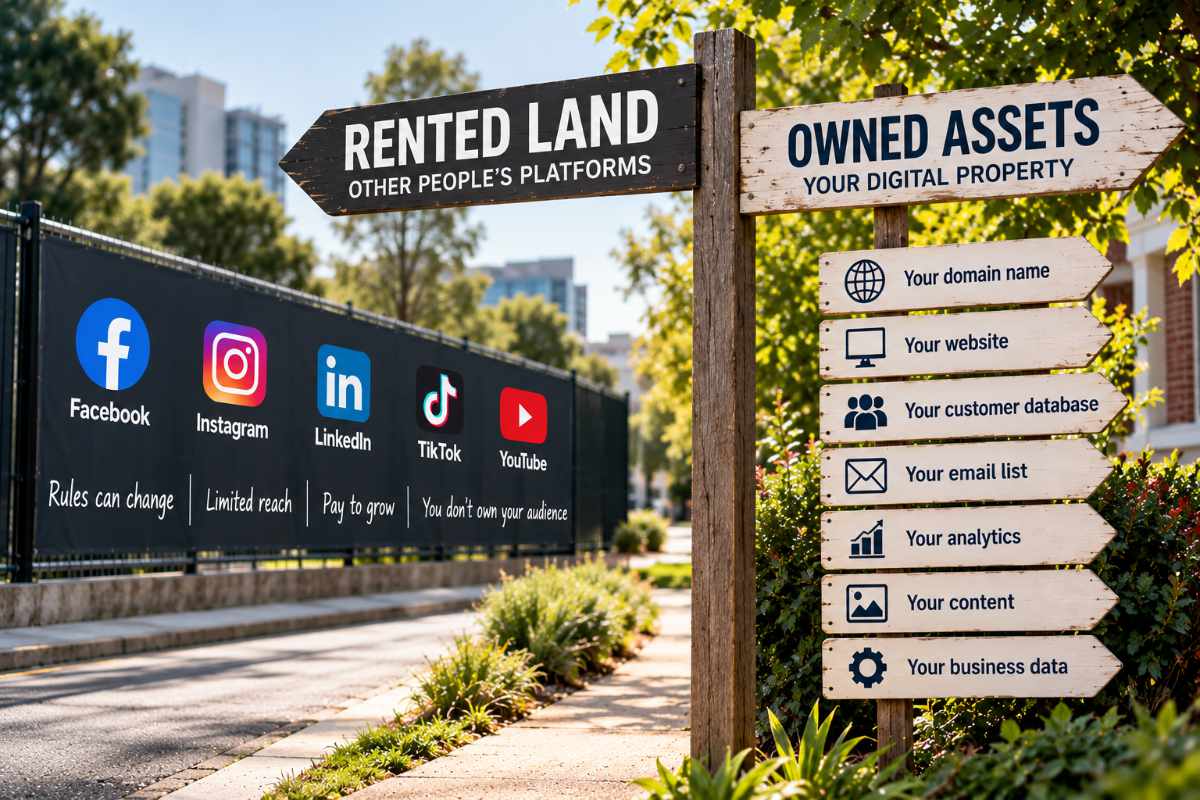
Social media is rented land
Facebook, Instagram, LinkedIn, TikTok and other social platforms can all be extremely valuable business tools.
But you do not own them.
You do not own your Facebook Page in the same way that you own your business assets. You are using Meta's platform under Meta's terms.
The same applies to your followers.
Having 5,000 Facebook followers is valuable, but you cannot simply take those 5,000 people with you if you decide tomorrow that Facebook is no longer the right platform for your business.
Compare that with a database of customers and prospects who have given you permission to communicate with them. That is a business asset you can manage independently of a particular social network.
This does not mean businesses should stop using social media.
It means we should understand its role.
Use rented land to help build assets you control.
Your website can be rented land too
This is where things become a little more interesting.
Most business owners would probably say, "That is fine. I have my own website."
But do you actually control it?
There are broadly two different approaches to building business websites.
SaaS website platforms
SaaS stands for Software as a Service.
With a SaaS website platform, you pay a company to use its website-building system. Hosting, software and management of the underlying platform are generally bundled together.
This can have significant advantages.
SaaS platforms can be easy to set up, convenient to manage and require less technical knowledge. For many businesses, those benefits can make them an entirely appropriate choice.
However, there is a trade-off.
Your website operates inside someone else's system.
The provider determines the features, pricing, technical limitations and terms of service. If prices increase or a feature changes, you generally need to accept the change or move elsewhere.
And moving elsewhere may not be as simple as taking a complete copy of your existing website and installing it with another provider.
You may be able to export your content or data, but rebuilding the actual website on another platform can still be required.
In other words, you may own your content, but not necessarily the system that turns that content into your website.
Open-source websites are different
An open-source content management system such as WordPress takes a different approach.
WordPress itself is open-source software released under the GNU General Public License.
That gives users freedoms that are fundamentally different from using a closed SaaS platform, including the ability to use, modify and move the software.
If your WordPress website is hosted with one provider and you decide you are unhappy with them, the website can generally be moved to another compatible hosting provider.
You are not required to stay with the company that originally built or hosted it.
That does not mean an open-source website has no dependencies.
You still need hosting. You may use commercial plugins, extensions, themes or third-party services. Someone also needs to maintain, update and secure the website.
But the underlying principle is different.
You have considerably more control over where your website lives and who manages it.
Your domain name matters even more
There is another digital asset that every business owner should check: their domain name.
If your business uses yourbusiness.com.au, do you know who the registered holder is?
Do you have access to the domain account?
Is it registered using an email address that you control?
A website can be rebuilt.
A Facebook Page can be replaced.
But losing control of the domain your customers know, your email addresses use and Google associates with your business can create a much bigger problem.
Your domain should be treated as an important business asset.
So what should your business actually own or control?
You do not need to abandon Facebook, Instagram, LinkedIn, SaaS products or any other third-party service.
They can be incredibly useful.
Instead, think about the balance between the platforms you use and the assets you control.
Ideally, your business should maintain control over important assets such as:
- your domain name
- your website content and access
- your customer and prospect database
- your email marketing list
- your business email accounts
- your Google Business Profile
- your analytics and advertising accounts
- your brand assets, photographs and original content
- your important business data and appropriate backups
Then use platforms such as Facebook, Instagram, LinkedIn and Google to help people discover and interact with those assets.
Ask yourself: what happens if I leave?
There is a very simple question you can ask whenever you introduce a new digital platform into your business:
"If I decide to leave this provider tomorrow, what can I take with me?"
Can you export your contacts?
Can you move your website?
Can you access your data?
Can you transfer your domain?
Can another provider take over?
Will you lose years of work?
The answers do not necessarily mean that you should not use the service.
Sometimes renting is the right business decision.
But you should know what you are renting.
Build on rented land — but build your own property too
Facebook's latest link restrictions will probably not be the last time a major digital platform changes its rules.
Algorithms will change. Subscription models will change. Features will come and go. New platforms will appear and others will disappear.
Businesses cannot control that.
What we can control is how dependent we become on any single platform.
Use social media. Use Google. Use SaaS tools when they make sense. Take advantage of the reach and technology these platforms provide.
But at the same time, keep investing in the digital assets your business can control.
Because rented land can be a fantastic place to attract an audience.
It is simply not the only place you should build your business.